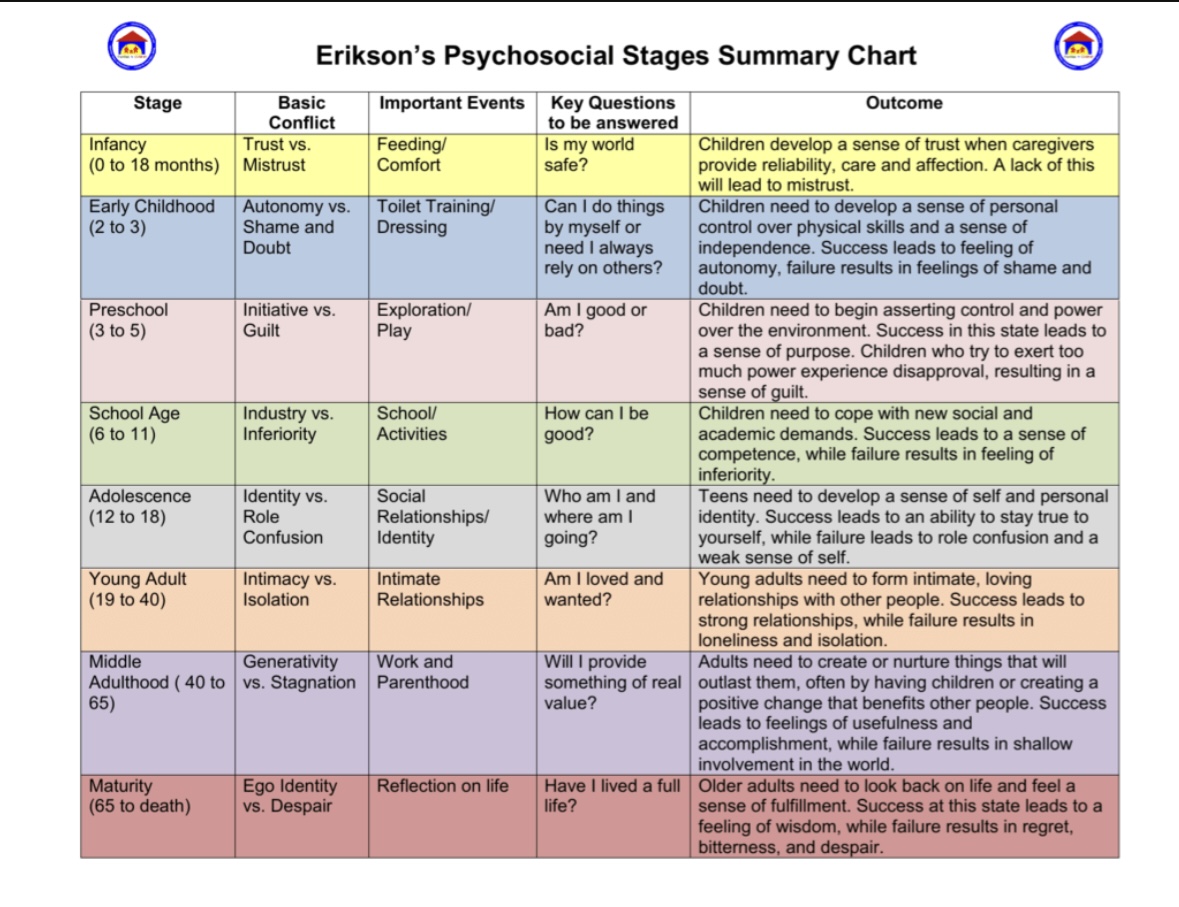
Erikson's Stages of Psychosocial Development
Erik Erikson proposed that people move through eight stages across the lifespan, each centered on a core tension — trust vs. mistrust in infancy, identity vs. role confusion in adolescence, intimacy vs. isolation in young adulthood, and so on. How each tension resolves shapes the strengths (or vulnerabilities) a person carries into the next stage.
In session, this framework is useful for locating where a current struggle sits developmentally — for instance, whether a client's present difficulty with closeness traces back to unresolved questions about identity, or whether a stalled sense of purpose connects to an earlier stage that didn't fully resolve. It gives us shared language for "why does this keep showing up," without pathologizing it.
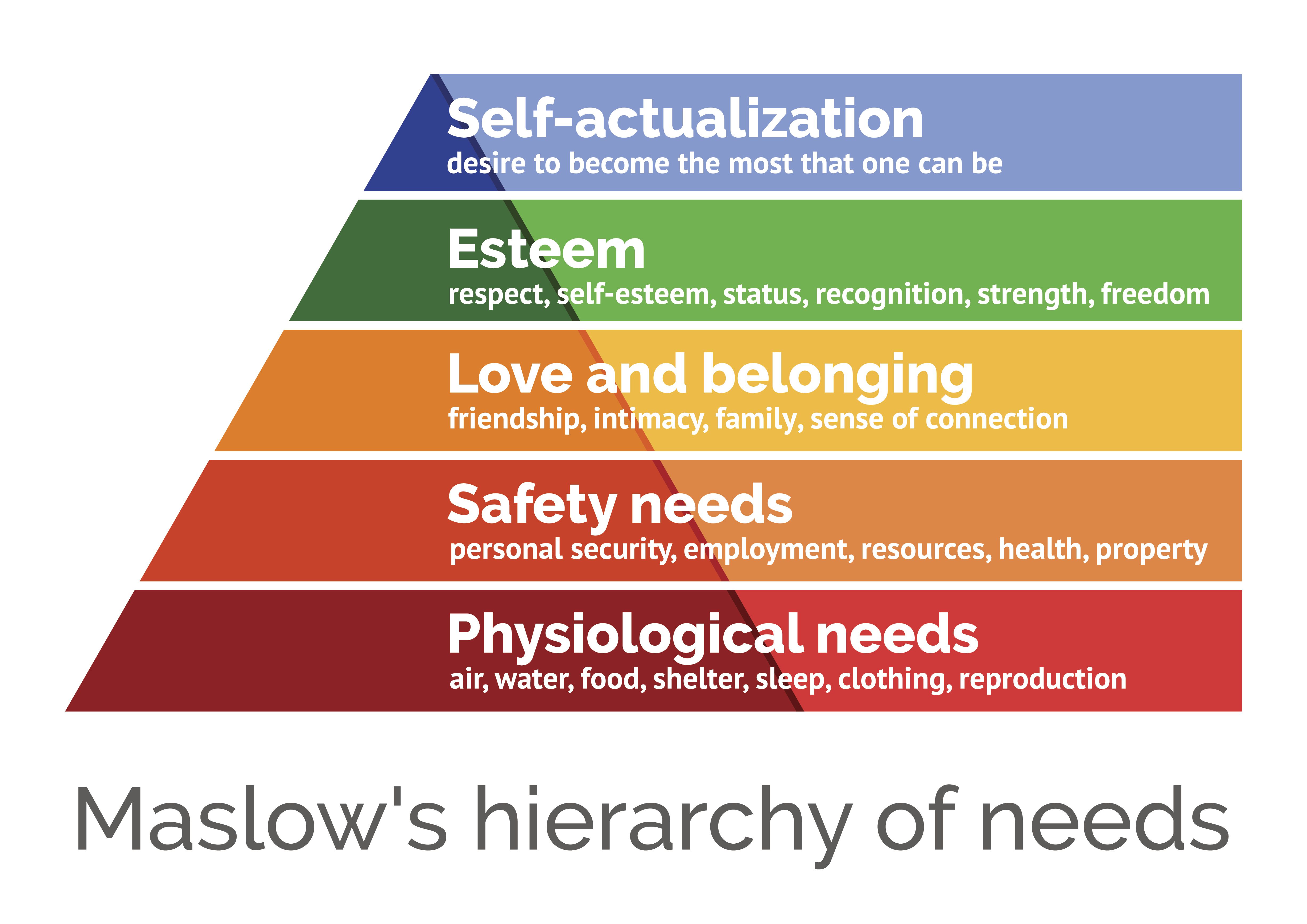
Maslow's Hierarchy of Needs
Abraham Maslow's model organizes human needs into a hierarchy — physiological needs and safety at the base, followed by love and belonging, esteem, and self-actualization at the top. The premise is straightforward: it's difficult to focus on growth or meaning while more foundational needs go unmet.
I use this as a quick diagnostic lens with clients — if therapy feels "stuck," it's often worth checking which level of the pyramid actually needs attention first. Someone navigating housing instability or an unsafe home environment isn't failing at self-actualization; the work sometimes needs to start lower down, and that's not a setback, it's the right order of operations.
Cass' Model of Homosexual Identity Formation
Developed by Vivienne Cass (1979), this was one of the first stage models describing how individuals recognize, accept, and integrate a gay or lesbian sexual orientation into their overall identity. Cass proposed that identity develops through the interplay of self-perception, behavior, and how a person believes they're perceived by others — and that movement through the stages is non-linear, with the possibility of pausing or settling at any point along the way.
- 01Identity Confusion — first awareness that one's feelings might not match assumed identity.
- 02Identity Comparison — weighing the possibility of being gay/lesbian against a sense of alienation.
- 03Identity Tolerance — tolerating, rather than embracing, the identity; cautious contact with community.
- 04Identity Acceptance — more positive, affirming connections; reduced isolation.
- 05Identity Pride — strong identification with LGBTQ+ community and culture.
- 06Identity Synthesis — the identity becomes one integrated part of a whole, unified self.
Clinically, this model helps normalize what can otherwise feel like a confusing or even alarming process — reminding clients that ambivalence, selective disclosure, or moving between stages isn't a sign that something is wrong with them, but a well-documented part of identity development.